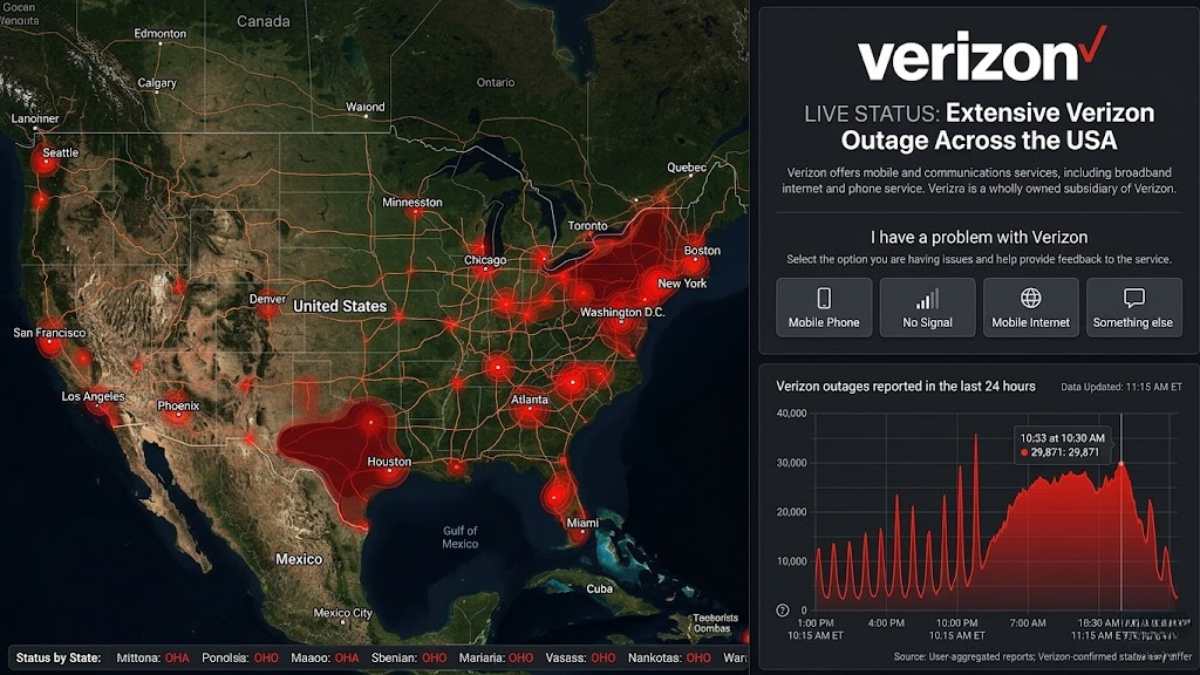
Verizon Outage – For millions of Americans, a working phone signal is no longer a luxury. It is part of everyday survival. People use it to call family, run businesses, check maps, send work messages, verify bank accounts, and reach emergency services. That is why the Verizon Outage quickly became more than just a technical issue. It became a national frustration. As service problems spread across the United States, customers reported dropped calls, failed texts, broken data, and phones suddenly showing SOS mode. What started as a service disruption soon turned into one of the biggest talking points of the day.
Verizon Outage leaves customers confused and frustrated
One reason the Verizon Outage generated such a strong reaction is because mobile service problems feel very personal. When a streaming app fails, people can wait. When social media is down, people complain and move on. But when your phone suddenly cannot call, text, or load data, it feels more serious. A phone is now tied to almost every part of life.
That is exactly what made this Verizon Outage stand out. Users were not dealing with a niche app failure or a minor slowdown. They were dealing with the loss of a core utility. For many people, the first sign of trouble came when calls stopped going through or messages were delayed. Others noticed that their phone had shifted into SOS mode, which only added to the confusion. Many customers did what people always do in moments like this. They went online to ask the same question. Is Verizon down right now?
That question spread fast, and so did the frustration behind it. People want answers quickly when basic service stops working. Silence from a carrier, even for a short time, can make the problem feel even bigger.
Why the Verizon Outage felt so disruptive
The timing of the Verizon Outage made it worse. Service problems that hit during the middle of the day create a different kind of stress than issues that happen overnight. People are actively using their phones for work, meetings, navigation, banking, and communication. A daytime outage can interrupt productivity and create immediate confusion.
For remote workers, this meant missed calls and broken communication. For travelers, it meant trouble with directions and ride bookings. For families, it meant uncertainty when they could not reach someone who was supposed to check in. In some cases, even small delays can create larger worries. A parent expecting a text from school, a contractor waiting for client approval, or a customer trying to reach a medical office may feel the impact instantly.
That is why the Verizon Outage became such a wide-reaching story. It touched normal people doing normal things. It was not abstract. It was happening in real time to customers who rely on their phones for almost everything.
SOS mode made the Verizon Outage even more alarming
One of the most talked-about parts of the Verizon Outage was the number of customers reporting that their phones were stuck in SOS mode. For many users, that is one of the most unsettling things a phone can display. It instantly suggests that normal service is gone and only emergency calling might still be possible.
Even users who had never paid much attention to SOS mode before suddenly found themselves staring at it and wondering what had happened. When a phone loses access to the regular network, people do not always know whether the issue is local, device-related, or part of a bigger service failure. That uncertainty only added to the tension.
The visual effect matters too. Seeing SOS on a phone does not feel like a routine glitch. It feels urgent. It feels like something is wrong beyond a simple delay. That is part of why the Verizon Outage spread so quickly as a news topic. Once people saw their phones behaving in an unfamiliar and alarming way, they immediately searched for answers.
The Verizon Outage shows how dependent Americans are on wireless service
This event was also a reminder of how deeply mobile service is woven into modern American life. Years ago, a temporary phone issue might have meant inconvenience. Today, it can affect work, transportation, money movement, digital security, and family communication all at once.
The Verizon Outage highlighted a simple truth. People do not just use their phones for conversation anymore. The phone is often their office, wallet, map, ticket, calendar, and emergency backup. That means a network failure can ripple outward much faster than many realize.
For businesses, even a short disruption can create missed leads and lost time. For gig workers, a mobile outage can mean delayed income. For families, it can cause real stress when someone cannot be reached. This is why network reliability now feels like infrastructure, not just a customer perk.
When the Verizon Outage spread, it became clear that mobile service is no longer something people can casually do without for long stretches. Expectations are higher because reliance is deeper.
Customer trust takes a hit when outages happen
Every major carrier sells more than data plans and call quality. It sells trust. Customers choose a network because they believe it will work when it matters. That trust is one of the most valuable assets a telecom company has, and it can be damaged quickly during a major service interruption.
The Verizon Outage put that trust under pressure. Even customers who were not directly impacted likely noticed the flood of complaints and asked themselves whether their own service could be next. Existing users wanted updates. Potential customers may have started comparing providers. Competitors, whether directly or indirectly, benefit whenever a major carrier is seen as vulnerable.
That is why response matters so much during an outage. People understand that technical failures can happen. What they judge just as strongly is how a company communicates during the disruption. Clear updates, fast acknowledgment, and practical guidance help reduce panic. When people feel left in the dark, the damage becomes larger than the outage itself.
For Verizon, the challenge was not only restoring service. It was also restoring confidence.
The Verizon Outage quickly became a national conversation
Another reason this story took off so quickly is because wireless outages are highly visible. The moment service breaks, people start talking. Those who still have Wi-Fi head to social platforms. Those with partial service compare notes. Screenshots circulate. Questions multiply. The outage becomes both a technical event and a public conversation.
That is what happened with the Verizon Outage. It was not just experienced privately by one neighborhood or city. It became a shared national topic. Customers from different states were all describing similar problems, and that pattern created momentum. Once enough people realize an issue is widespread, it stops feeling like a bad signal day and starts feeling like a major failure.
This is one of the realities of modern outages. The public reaction unfolds almost as fast as the disruption itself. That means carriers are not only fixing the problem behind the scenes. They are also operating in the middle of a very public pressure cycle.
Why outages create more than technical problems
A lot of people think of outages as pure engineering events, but the real-world impact is broader than that. A network disruption creates emotional, financial, and logistical problems at the same time. People become anxious when they cannot communicate normally. Businesses lose time. Plans get delayed. Trust gets shaken.
The Verizon Outage is a strong example of that. Even for customers who lost service only temporarily, the sudden loss of connection likely changed part of their day. A missed call can mean a missed opportunity. A failed text can create confusion. A broken map connection can cause delay and stress. These are small incidents individually, but when multiplied across thousands or millions of users, they become significant.
That is what makes these outages so important in the public eye. They are not only about technology failing. They are about daily life getting interrupted in ways people feel immediately.
Verizon customers want answers after the outage
After any major disruption, the next big question is always the same. What caused it? Customers want a clear explanation, and they want reassurance that the same problem is not likely to happen again. That demand is understandable. People pay monthly bills expecting stability. When that stability breaks, they want transparency.
The Verizon Outage has left many customers looking for those answers. Some will want technical details. Others will mainly want to know whether service is fully safe and stable again. Many will judge Verizon not only by how quickly service returned, but by how honest and useful its communication is afterward.
This is especially true because outages do not happen in a vacuum. Every major failure becomes part of a company’s reputation history. Customers remember how they felt during the disruption. If they felt informed and respected, the damage may fade. If they felt ignored or confused, the memory lasts longer.
That is why post-outage messaging matters so much. Once the network is back, the trust repair work really begins.
The Verizon Outage also raises bigger questions
Events like this often trigger broader public discussion about telecom reliability in the United States. Americans expect strong wireless service, especially from the largest carriers. When a major outage happens, it raises uncomfortable but necessary questions. How resilient are these networks? How quickly can problems be isolated? How prepared are carriers to handle sudden failures? How much backup do customers really have when mobile service goes down?
The Verizon Outage may be remembered not only as one bad day for customers, but also as another reminder that digital life depends heavily on systems most people rarely think about until they stop working. Wireless infrastructure is easy to take for granted when it works. When it fails, the dependence becomes visible instantly.
That visibility is why these stories often grow beyond telecom news and become mainstream headlines. They touch basic modern life. Everyone understands what it feels like to lose signal at the wrong time.
What customers can do during a major outage
While the focus is naturally on the company, the Verizon Outage also reminds users of a few practical realities. When a major carrier goes down, people often rely on Wi-Fi calling, messaging apps connected to internet service, offline maps, saved contact information, and alternative ways to verify appointments or plans. Those small precautions can make a big difference in stressful moments.
Of course, customers should not have to build their lives around carrier failures. Reliable service is the standard people are paying for. But modern outages are a reminder that digital resilience matters at the personal level too. Having key contacts saved, knowing how to use Wi-Fi calling, and keeping important information accessible without mobile data can reduce stress during a disruption.
That lesson may not be the headline, but it is one many customers take away after a day like this.
Final thoughts
The Verizon Outage today triggered major service complaints across the U.S. because mobile service is now one of the most essential parts of modern life. When a network of this size runs into trouble, the impact spreads quickly across work, travel, family communication, and daily routines. This was not just a brief inconvenience for a handful of users. It became a major frustration because people depend on their phones for almost everything.
What made the Verizon Outage especially memorable was the mix of confusion, visibility, and disruption. Customers saw SOS mode, failed calls, broken texts, and data problems all at once. That made the situation feel urgent and unsettling. It also reminded everyone how much trust carriers are expected to carry every single day.
In the end, the biggest issue is not only what went wrong, but how confidence is rebuilt afterward. Customers want stable service, honest communication, and reassurance that the network they rely on can deliver when it matters most. The Verizon Outage may fade from the headlines, but for many users, it will remain a clear reminder of how fragile connected life can feel when the signal suddenly disappears.
FAQs
What is the Verizon Outage?
The Verizon Outage refers to a major service disruption that caused customers in different parts of the United States to report problems with calls, texts, and mobile data.
Why were phones showing SOS during the Verizon Outage?
Many phones showed SOS mode because they were unable to connect normally to the Verizon network during the service disruption.
Did the Verizon Outage affect calls, texts, and data?
Yes, customers reported a mix of failed calls, delayed messages, and data connectivity issues during the outage.
Why did the Verizon Outage get so much attention?
It drew major attention because Verizon is a large national carrier and mobile service is essential for work, travel, communication, and emergency needs.
How do outages like the Verizon Outage affect customers?
They can interrupt business, delay travel, prevent communication, and create anxiety when people cannot reach family or access important services.
What is the main takeaway from the Verizon Outage?
The biggest takeaway is that wireless service is now a critical part of everyday life, and even a temporary disruption can have a wide and immediate impact.